Body condition score: is your pet the right weight?
By Josh · Reviewed and updated: 2026-09-16
A scale tells you how heavy your pet is. It does not tell you whether that weight is right. A lean, muscular Labrador and a fat Labrador of the same breed can weigh the same number and be in completely different health. Body condition score is the check that actually answers the question, and you can do it with your hands in under a minute.
The nine-point scale
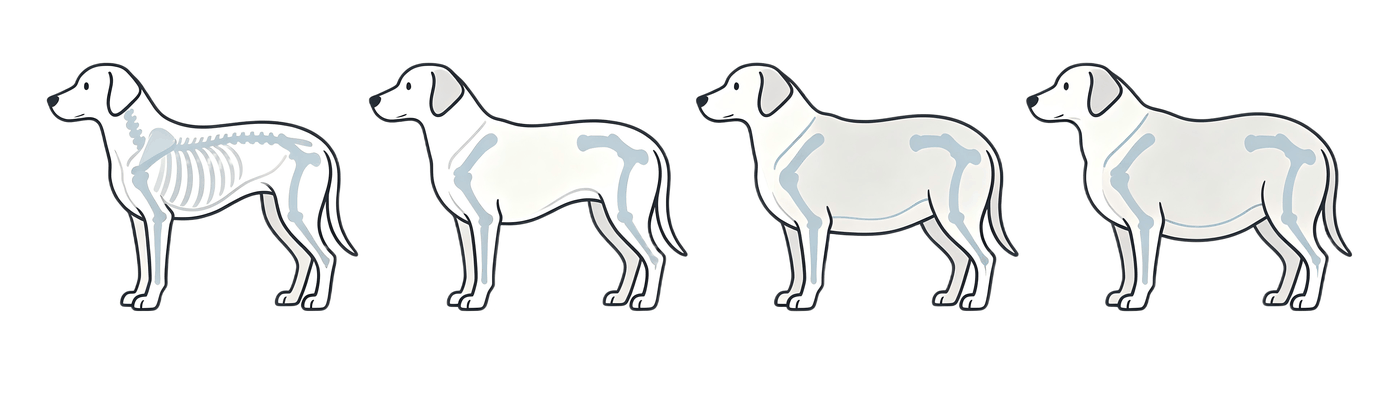
Vets use a nine-point body condition score, usually shortened to BCS. One is emaciated, nine is severely obese, and the ideal range for most pets is four to five. It is a subjective score, which is exactly why it works: it describes what you can feel on your pet, not what an average pet of that breed is supposed to weigh.
The three checks
- 1. Feel the ribs Run your flat hands along both sides of the chest, behind the front legs. At an ideal score the ribs feel like the back of your hand: you can find each one easily under a thin layer of padding, but you cannot see them.
- 2. Look at the waist from above Stand over your pet and look down at the back. An ideal pet narrows behind the ribcage, so the outline dips in before it widens again at the hips. If the outline runs straight from ribs to hips, there is no waist.
- 3. Look at the tuck from the side Kneel beside your pet at eye level. An ideal pet's belly rises from the bottom of the ribcage up toward the hind legs. If the belly line runs level, or hangs lower than the ribcage, there is no tuck.
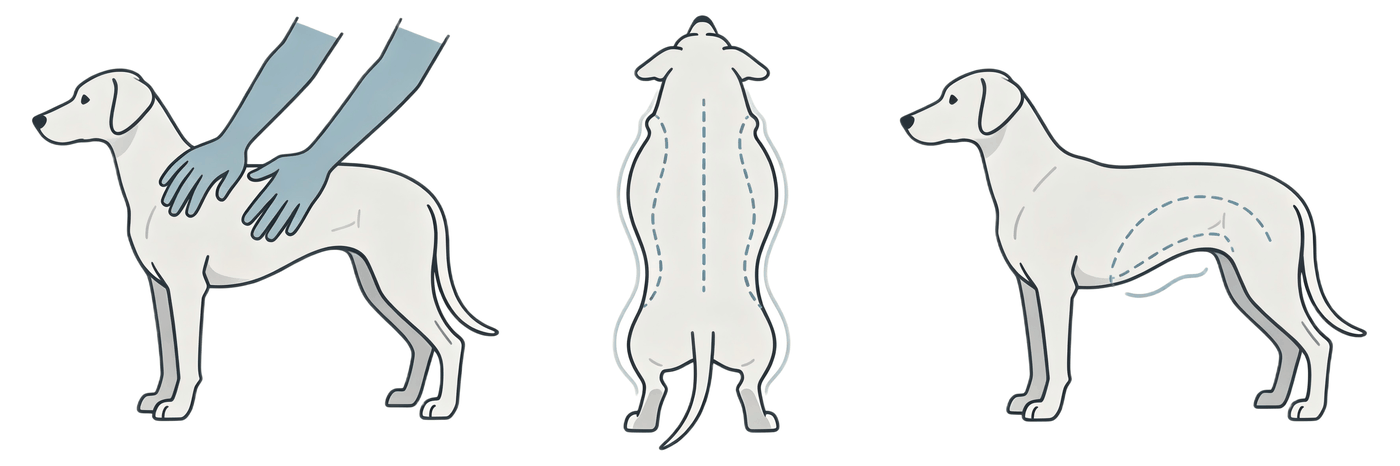
Do all three. Ribs alone can mislead you in a very furry or very muscular pet, and the waist alone can mislead you if the coat is long. When the three checks disagree, trust your hands over your eyes, and if you are still unsure, ask your vet to score the pet at your next visit — most clinics will do it in a minute at no charge.
What each band means
| Score | What you find | What it means |
|---|---|---|
| 1–3 | Ribs, spine and hip bones visible from across the room. Obvious waist and a sharp tuck. No fat layer under the skin. | Underweight. Needs a vet check. |
| 4–5 | Ribs easy to feel but not visible. Visible waist from above, visible tuck from the side. A small fat pad over the ribs. | Ideal. Keep the current plan. |
| 6–7 | Ribs hard to feel under a thick fat layer. Waist barely visible or absent. Slight or no abdominal tuck. | Overweight. Time to measure portions. |
| 8–9 | Ribs cannot be felt at all. No waist, broad back. Belly hangs noticeably; fat deposits over the tail base and spine. | Obese. Vet-supervised plan recommended. |
Why this matters more than the number on the scale
Over half of pet dogs and cats in developed countries are overweight or obese, and owners are poor at judging it by eye — studies of owner perception repeatedly find that owners underestimate their own pet's body condition. The consequences are not cosmetic. Excess body fat is linked to shorter lifespan, worse joint health, diabetes, and higher anaesthetic risk during surgery. In dogs, lifelong restriction to a lean body condition has been shown in long-term studies to delay the onset of osteoarthritis and extend median lifespan.
And unlike weight itself, body condition is something you can act on: if the score drifts out of the ideal band, the fix is a measured change to the daily food amount, which is exactly what the calculator gives you.
What to do at each score
Score 1–3: underweight
Do not simply add food and hope. Unintentional weight loss has medical causes — parasites, dental pain, kidney or thyroid disease — that feeding more will not fix. Book a vet appointment, and only increase the daily amount once a cause has been ruled out or treated.
Score 4–5: ideal
Nothing to change, but keep checking every two to four weeks. Pets drift out of condition slowly and unnoticed. Recheck the number on the scale too, so that a rising trend shows up before the score moves.
Score 6–7: overweight
This is the band where careful portion control works best, and where early action prevents the harder problem of obesity. Weigh your pet, note the score, and recalculate the daily amount using your target weight rather than the current weight and a weight-loss goal. Then reduce by no more than 10% at a time and reassess in two to four weeks. Aim for 1 to 2% of body weight lost per week in dogs.
Score 8–9: obese
Ask your vet to supervise. Severely obese pets may have concurrent conditions that make unsupervised calorie restriction risky, and the target weight is easy to set too low. Once you have a veterinary target weight and a plan, this calculator can do the arithmetic for you.
How often to check
Every two to four weeks is enough for a healthy adult pet, and it takes less than a minute once you know the three checks. Weekly if your pet is on a weight-loss plan, because that is when drift is fastest and when you most need the feedback. Puppies and kittens change shape constantly as they grow and should be scored by your vet at vaccination visits rather than judged at home.
Write the score down, with the date. A score of five today and a score of six in three months is far more informative than either number alone, and it is the single most useful thing you can bring to a vet appointment.
Frequently asked questions
What is a healthy body condition score for a dog or cat?
Four or five on the nine-point scale is ideal for most adult dogs and cats. One to three is too thin and needs a veterinary check; six to seven is overweight; eight to nine is obese and should be managed with veterinary supervision.
My pet is a healthy weight on the scale but looks fat. Which do I trust?
Trust body condition, not the number on the scale. Scale weight only means something relative to the pet's frame and muscle mass. A body condition score describes what is actually on the body, which is why vets use it alongside weight rather than instead of it.
How do I check body condition on a very fluffy pet?
Go by your hands rather than your eyes. Feel the ribs behind the front legs, run your fingers down the spine, and feel for the hip bones. Long coats hide the waist and tuck completely, so for a long-haired pet the rib check is the reliable one.
Can I use the body condition score to work out how much to feed?
Yes, and that is how it is meant to be used. Score the pet, then use the calculator with either the current weight and a maintenance goal, or the veterinary target weight and a weight-loss goal. Re-score every two to four weeks and adjust the amount by no more than 10% at a time.